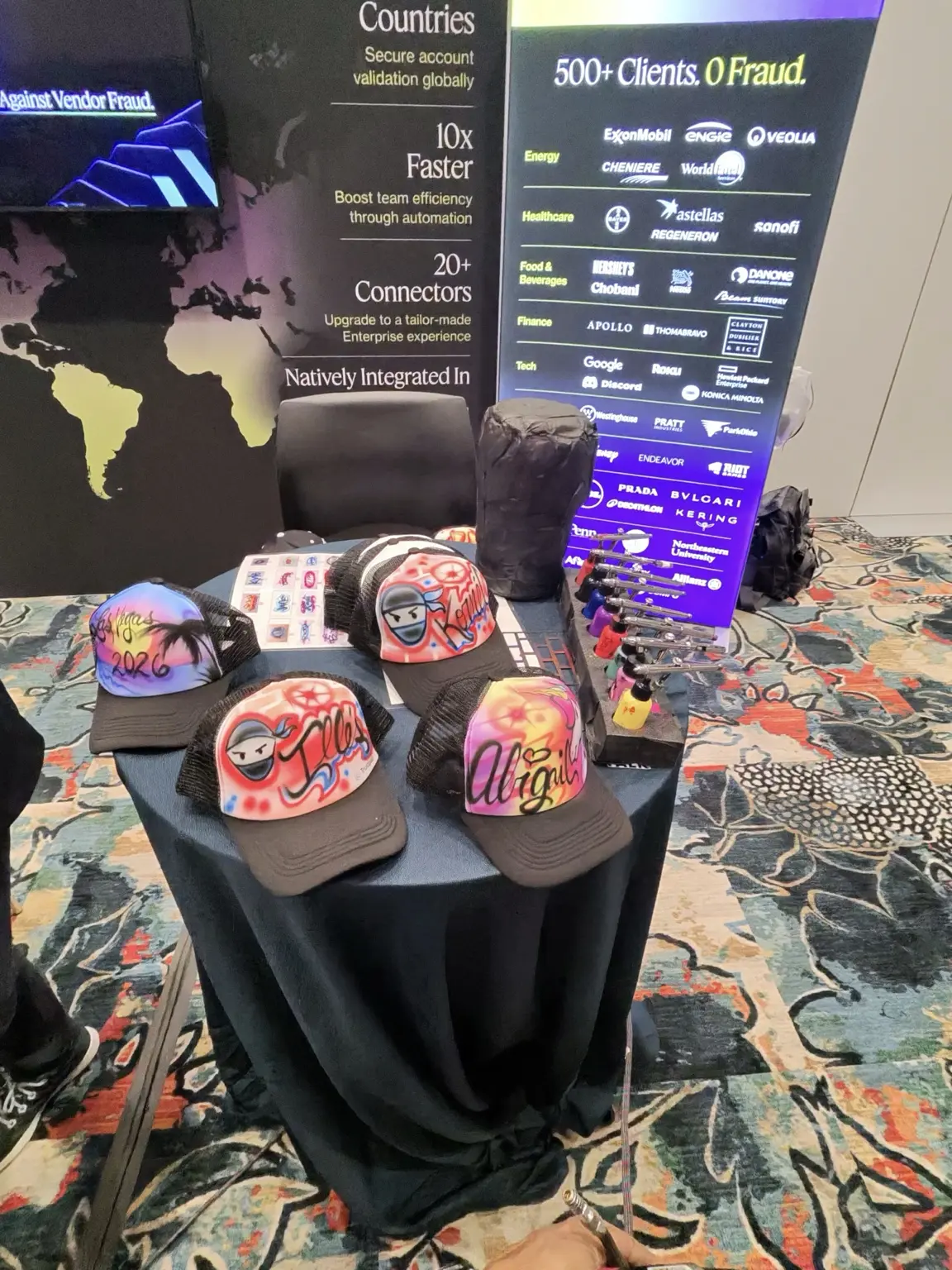
A company logo and live airbrush art do not have to compete for space. When both are planned as one product, the hat can remain unmistakably on-brand and still feel personal enough that a guest wants to wear it after the event.
3JS Airbrushing has used this approach for corporate celebrations, conferences and trade-show activations. For a Docusign corporate event in San Diego, for example, the logo was screen printed on the hats before the event and live artists added guest personalization on site. That separation gave the client consistency while keeping the experience interactive.
Three ways to combine a logo with live airbrushing
| Branding approach | Best for | What happens live |
|---|---|---|
| Logo applied before the event | Consistent marks, detailed logos and higher-volume programs | Artists add names, colors and approved graphics around the reserved logo area |
| Approved logo stencil or simple live mark | Simple artwork that can be reproduced cleanly at event speed | The artist paints the approved element as part of a limited design menu |
| Brand-inspired theme | Campaigns that want the feeling of the brand without repeating the exact logo | Guests select from approved colors, words and graphics tied to the event concept |
The right method depends on the logo, the hat, the number of guests and the desired level of control. A multicolor logo with small text is usually better applied before the event. A simple symbol may work as an approved stencil. A campaign built around a color palette or theme may not need the logo on the front panel at all.
Why pre-applying the logo often works best
Screen printing, heat application or another suitable production method can place the logo on every hat before guests arrive. The exact method depends on the blank product, artwork and quantity. The main advantage is repeatability: the mark has the same size, position and approved appearance across the entire activation.
Pre-application also protects live-event capacity. The artists are not rebuilding a detailed corporate mark for each person; they are creating the part guests value most—their own name, colors or design. That helps preserve the practical planning rate of approximately 25 finished items per artist per hour for streamlined event-ready choices.
If production speed is central to the event, read our guide to how long live hat airbrushing takes and the related artist staffing calculator.
Plan the logo zone and personalization zone together
A trucker hat has limited usable space, so placement should be decided before the blank hats are ordered. Common arrangements include:
- Small logo on the side or back: leaves the full foam front available for a guest name and artwork.
- Logo on one side of the front panel: creates a clear branded anchor with an open area for short personalization.
- Centered front logo: works when live art is intended as a border, color treatment or supporting accent.
- Branding on a tag or closure: keeps the entire front panel open while still identifying the sponsor.
Do not approve a logo position in isolation. Ask to see the complete plan showing where the largest guest name and widest approved design will go. Seams, curved panels and the hat color can reduce the available painting area.
What the creative team should provide
Early coordination prevents last-minute changes and gives the brand team a clean approval path. Send:
- The approved logo in AI, EPS, SVG or print-ready PDF format when available.
- A high-resolution transparent PNG if vector artwork is not available.
- Official color references and any restrictions on alternate color versions.
- Minimum-size, clear-space and background rules from the brand guide.
- The campaign name, event hashtag or approved short phrases.
- The expected quantity, guest count, event hours and planned hat colors.
The vendor should return a proof or sample that shows the logo, the personalization area and representative guest designs on the actual hat style. Final approval should cover the complete product—not only a logo floating on a digital template.
Ask one decision-maker to approve the hat blank, logo position, design menu and color palette together. Then freeze those choices before production begins. This reduces conflicting feedback from marketing, events and on-site staff.
Use a curated menu to keep the experience on-brand
Live personalization works best when it offers meaningful choice inside clear boundaries. 3JS commonly prepares a focused menu of event-ready designs that can include guest names, initials, flames, stars, flowers, city references or campaign-inspired graphics. The client can approve the menu before the event.
Brand colors can appear in fades, outlines and accent graphics, but contrast still matters. A dark logo and dark airbrush lettering may disappear on a black hat; a light foam front usually gives both elements more room to read. The chosen colors should be tested on the exact blank, not judged only on a monitor.
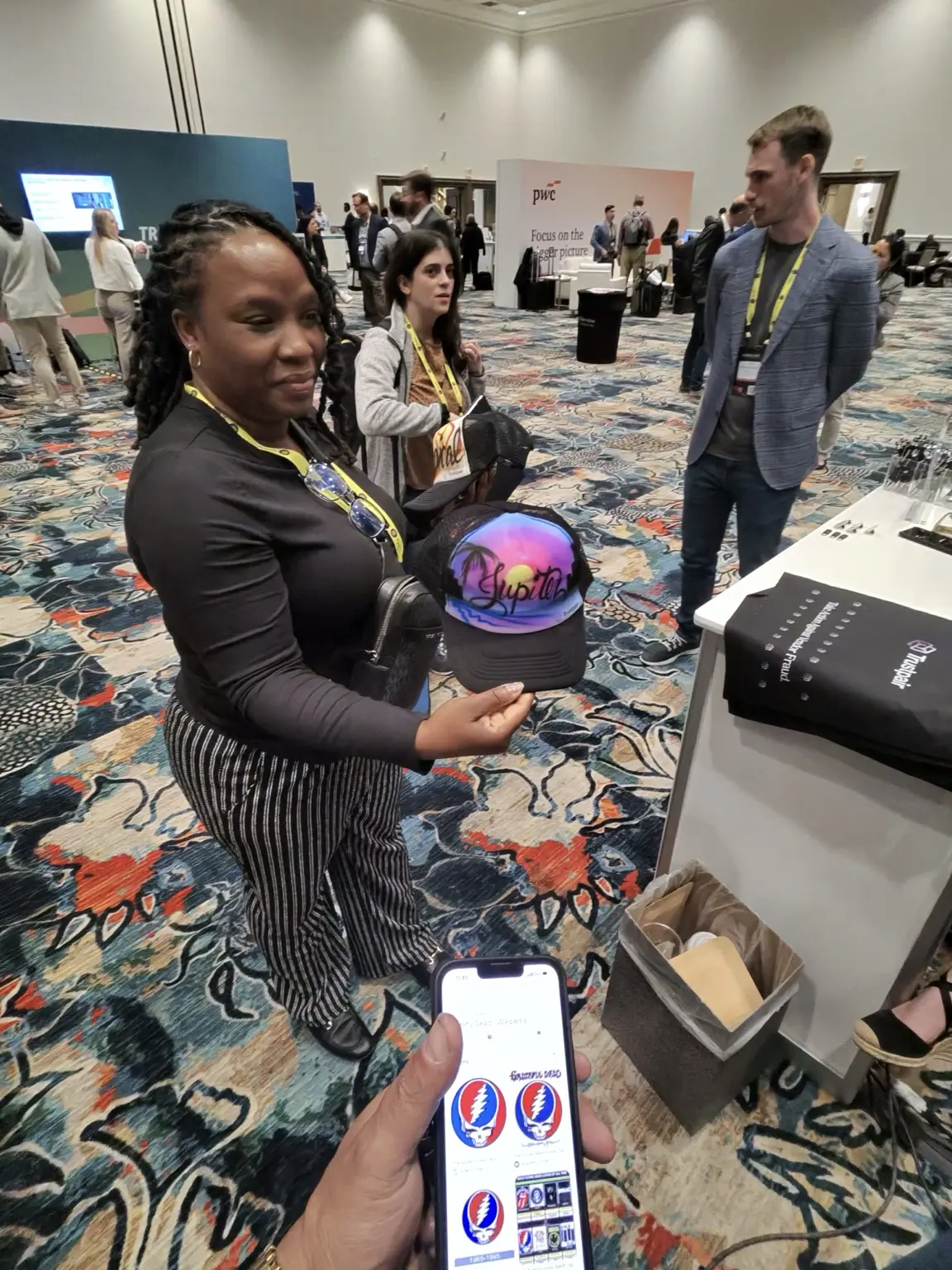
This approach supported recognizable corporate experiences for Trustpair in Orlando and Las Vegas, and for a Google anniversary celebration in Atlanta. In each case, the surrounding event identity and guest-specific artwork worked together to create a memorable takeaway.

Can the client provide the hats?
Yes, but the exact product should be reviewed before the full order is placed. Foam-front trucker hats are a popular choice because they provide a visible painting surface, yet not every foam, fabric or coating behaves the same way. A sample helps confirm:
- Whether the logo application is compatible with the material.
- How much open space remains for live artwork.
- Which paint colors are visible on the selected hat color.
- Whether seams or panel shapes interrupt names and graphics.
- How the finished hat should be handled and displayed.
If you are still choosing merchandise, compare hats with shirts, canvas bags and other options in our guide to the best products for live airbrush events.
A simple branded-hat planning checklist
- Confirm the audience, quantity and active customization window.
- Select the hat style and send a physical sample when possible.
- Choose whether the logo will be pre-applied, painted from an approved stencil or represented through a brand theme.
- Approve logo position, guest-design area and color palette.
- Approve a proof or finished sample before the full production run.
- Finalize the live design menu and guest ordering process.
- Confirm artist count, tables, chairs, power, lighting and line flow.
For the on-site details, use our live airbrush event setup checklist. You can also explore corporate event services, browse past work and review all customizable products.
Frequently asked questions
Can a company logo be put on the hats before the event?
Yes. Depending on the hat, artwork and quantity, the logo may be screen printed, heat applied or prepared with another suitable method before the live event.
Will the live airbrush design cover the logo?
It should not. The logo and personalization areas are planned together so the approved mark remains readable while guests still receive a unique design.
Can our company provide the hats?
Yes, subject to review. Send the exact style early enough to test its fabric, color, panel shape, logo position and available painting area.
What logo file should we send?
An approved vector file such as AI, EPS, SVG or print-ready PDF is ideal. A high-resolution transparent PNG may also work. Include brand colors and any minimum-size or clear-space rules.